12.06.2012

Spotlight on Amani Liberia Men


Amani Liberia doesn’t just strive to empower women. A few men are a part of the family as well. We hope to bridge the historically wide gap between men and women by allowing a safe environment of equality for them to work in together.

Ellis
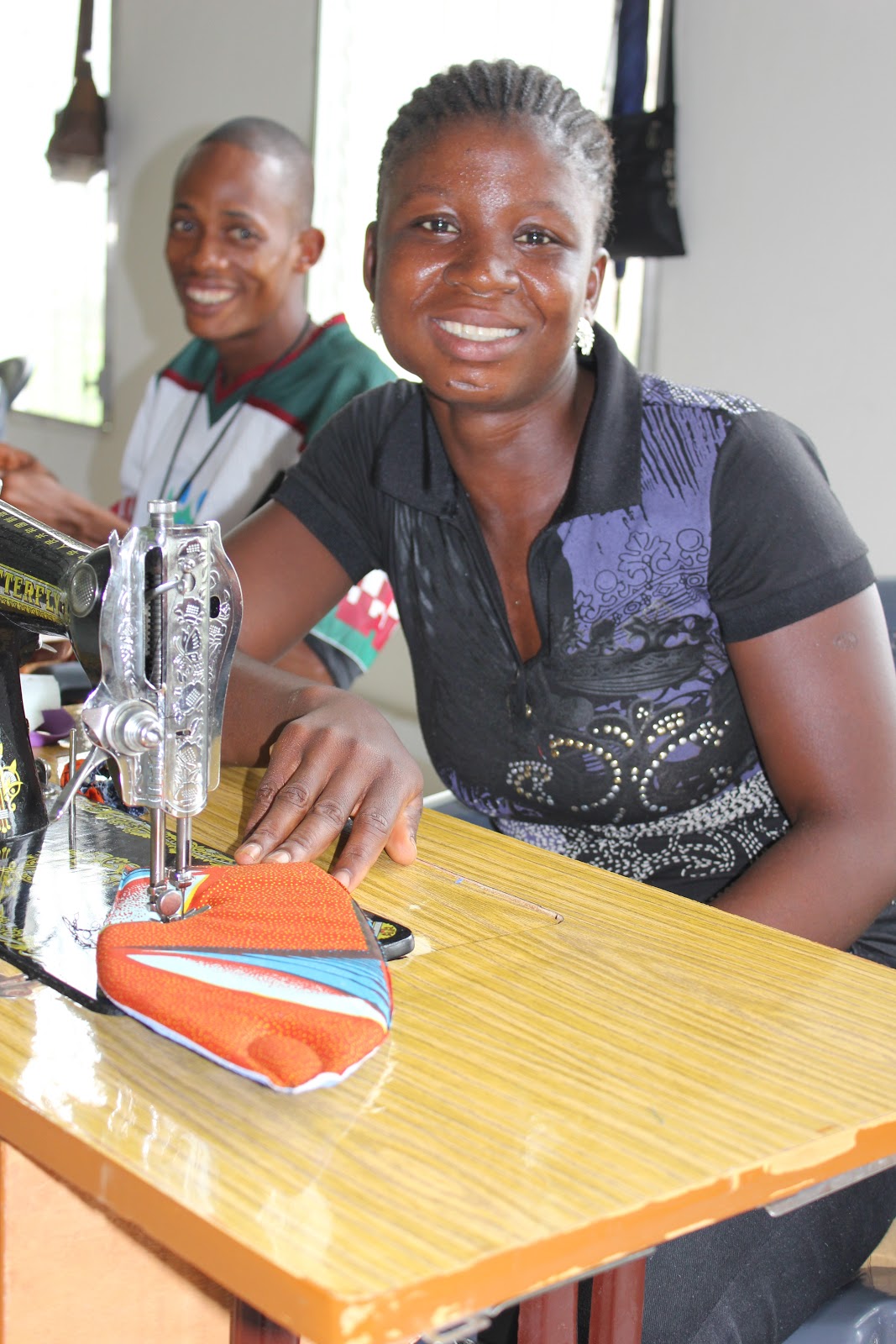
At Amani, Ellis, 28 sews many of Amani Liberia’s most complicated pieces, such as clothing with tricky pleats and zippers. He also teaches the women to sew on Mondays.

“Faster, faster, faster!” shouts a smiling Ellis, who is quick to laugh and very encouraging towards his struggling students one recent Monday. He gestures expressively with his hands and is eager to pass along his knowledge of sewing techniques. “They are improving, small-small (little by little),” he says gratification. Ellis trains them to control the treadle sewing machines and stitch straight. His trainees are currently working on a hot pad.

Ellis is a happily married man. He met his wife years ago when he was training to become a tailor, but he waited a long time before he began to pursue a relationship with her. “I was wanting to dress (move) to her, but I first wanted to make something of myself”. So he began a small tailoring business, which he still runs part-time. He and his wife have now been married for six years and share a two-and-a-half year old little girl.

Ellis whole-heartedly believes in equipping women with skills for a brighter future. “We need to get more people to work here and encourage them to learn. We have more sisters in the community, and Amani can help them.”

Ellis isn’t just helping to empower this generation; he also has his sights on the next generation of Liberian women, especially his daughter. “Amani can help me help myself to send my child to school.”

Ellis
                                                 

Austin
Austin, 23, stitches a wide variety of Amani products. “And, I fix the machines.” he adds with emphasis. Austin is a savior anytime one of the treadle sewing machines breaks down.

Although it takes Austin about an hour and a half to walk from his home to Amani each day, he loves his work---and his co-workers. “Their behavior is good towards me, and we are all learning from each other.”

Austin is an integral part of the Amani team for many reasons, especially during devotion. “We all pray, and I drum!” he exclaims. A common prayer during devotionals is one of thanksgiving for their jobs. “We pray for Amani, saying, ‘let it continue!’”

Austin lives with his parents and extended family. “We are more than 10!” Austin says of his many roommates. When asked if Austin is married, he shakes his head with a shy smile, saying, “No, but I got my girlfriend.” Austin explains that he wants to save money and build a house before marrying her, and the nearby women all interject vigorously, insisting, “Yes, he must first save to build a house for his wife!”

This isn’t the first time his fellow workers, almost all older women, have given him friendly advice. In fact, a visitor to Amani might get the sense that Austin has a lot of older sisters, always quick to offer clear instruction for life.

Austin has much to look forward to, but has only one humble prayer for the future: “I want to be well and come to work.”


Austin
                                                    

Morris
“I started sewing when I was small,” Morris, 35, explains. He picked up his sewing skills from a smattering of teachers. Morris was one of Amani Liberia’s very first members. He is a skilled and creative tailor who helped to develop many of Amani’s first products.

Morris lives in Guinea close to the Liberian border, just a few miles from the Amani Liberia building. He has been married for 10 years and has four children (5, 3, 2, and 1 years old).

Morris is appreciative of his Amani paycheck, which he receives twice a month. “I can feed my family and try to make small economy for myself so I can help myself for tomorrow,” he says.

Morris paints a picture of the favorite part of his day, the evening. After work he goes home, bathes, eats dinner with his family, and talks with his children around the table. “I advise them to go to school and to be serious so they can have a better future.”

When asked if he had anything else he’d like to share, he thinks carefully for a moment before answering. “I thank God for my life,” he says. His involvement with Amani came as result of a gentle urge from the founder of Amani ya Juu, Becky Chinchen. “I thank God for that,” he says earnestly. 


Morris

11.25.2012

A Typical Day for an Amani Liberia Woman: Esther, Regina, Yei, and Darlene

Esther

Esther, a 39-year-old mother and grandmother, wakes up at 5:30am each morning. “I carry the bucket to the pump. If you cannot carry the bucket soon, you will not get water!” she shares with wide eyes that giving the impression that this lady has had to deal with a dry pump on more than one occasion, and doesn’t plan on letting it happen again.

Esther prepares food for her family and sends her children off to school. Then, she sometimes goes to the market to buy food for her family or her bucket. She runs a micro business from her head---she sells pepper, spices, candies, ground pea candy (peanut brittle), and other treats out of a plastic bucket she carries allover the community.

At Amani, Esther cuts cloth or learns to sew. She has only been at Amani for about a month but already feels intense community amongst her coworkers. “We are here together, friendly...if I am not here, I am missing these people,” she says, looking about the room.

After work, Esther often goes to night school, where she is currently completing 9th grade. Her favorite part about school is reading “They got some good stories in it!” she says of her school books, then rattles off the plot of a story she is reading this week about some farmers with a car---“their own car!”---she exclaims.

Esther


Regina
Regina, 33, wakes up at 4am each day. She makes breakfast for her family and walks “a looong time” to gather clean water. She bathes her 3 children and sends them off to school.

“Then I will go to the market to buy food, then I dress, and come to work.”

Regina usually cutes cloth, but is a highly capable seamstress who is rapidly learning to master new products each day, which she lists on her fingers with satisfaction:  “I make hot pad, coaster, belt, napkins, and placemat.”
In addition to developing lifelong sewing skills each day, Regina is earning income for her family. “I love Amani---Amani is helping me, I am getting money to send my children to school. I want for Amani to continue so I get work to do every day.
Regina


Yei
Yei, 20, wakes up at 4am, “and I work on small-small things” like cooking and cleaning. She baths her children and cooks. After arriving at Amani, she begins to produce a variety of products. One of the most complicated pieces Yei makes is what she calls teddy bears, a blanket term used here for stuffed animals (Amani’s “teddy bear” is actually an elephant backpack for children).

“I learned to sew at Amani. I also have a machine at home, and I make skirts.” Yei says.

Yei is very thankful for her job at Amani, which has come to prove essential to her young son’s future. When asked where her bi-monthly paycheck goes, she explains with an air of gentle determination. “I will do good things with it, like pay for my child’s school.”

Yei


Darlene
Darlene, 27, wakes up at 5:30am each day. “I clean my room, I put hot water on, bathe my daughter and find breakfast for her, then send her to school.

“After that, I will get ready, and put my market down (sets it up).” Her market stall sells cosmetics, shoes, clothing, and other odds and ends.

Darlene’s family has adjusted to every curve ball life has thrown at them. Her mother was unable to care for her two little sisters, so both live with Darlene and her husband. When Darlene comes to Amani, one sister tends to her market stall while the other goes to school. In the afternoon, the two trade places.

Darlene started her market stall with a $100 loan from Amani Liberia over a year ago, which she promptly paid back and has now increased ten-fold. She has plans to expand into an appliance shop soon.

Clearly, Darlene is already a savvy businesswoman, and has the perfect skill set to train as the manager for Amani Liberia’s CafĂ©, which is currently under construction. Darlene is learning many useful tasks at Amani, further broadening her already considerable resume. Some tasks are easier, like cutting, but some are challenging. “Working here requires learning,” says Darlene. She seems happy to meet the challenge.

Darlene

To see Ophelia, Felicia, and Theresa's stories, click here.

11.18.2012

A Typical Day for an Amani Liberia Woman: Ophelia, Felicia, and Theresa


Ophelia
Ophelia, age 30, takes a break to breastfeed her one-year-old son, Wilson, who glances up, smiles, and gets down to the business of eating. “I wake up at 4 o clock. I bathe my five children, I bathe myself, I make hot water for cooking.”

Ophelia walks to work each day from her home in Camp Four, a community in Yekepa several miles from the Amani center.  It takes her about two hours to walk the distance, which she manages with Wilson strapped on her back.

Ophelia is one of Amani’s most talented seamstresses, which is more impressive when you learn she can work on the machine while simultaneously wrangling a very inquisitive son. Ophelia is one of the first to arrive and last to leave Amani each day, where she churns out an astonishing number of folded totes and other products---all between Wilson’s frequent feedings.

When Ophelia gets home in the evening around 6pm, she is happy to say that she can unwind rather than cook; her 10-year-old daughter is in charge of dinner.

Ophelia takes a break to give Wilson a bath

Felicia
Felicia, 24, wakes up each day around 5am. She prepares water and uses a bucket to bathe herself and her four boys, and then sends them off to school. She prepares the meal her children and husband (a student at ABCU) will eat for dinner that night and heads to Amani.

Currently, Felicia works as a cloth cutter, “but I want to learn tailoring also!” She exclaims. Felicia has begun attending Monday sewing lessons.

Anyone who asks about favorite hobbies will get a similar answer when talking with the Amani members; they love to sing. Felicia, however, says that though she loves music and singing, “I don’t have a good tune”. For entertainment, Felicia has a different response: “I love to play football!” She learned to play when she was young and plays with the children often.

Felicia

Theresa
“I wake up at 5am and get some water on the fire for a bath for my husband and children.” Then Theresa’s two older children go to school and her husband departs for a nearby university where she hopes to attend if she can find a scholarship. “And then I sometimes go to the market, maybe to buy coal to cook with. Sometimes I plait my baby’s hair.”

Theresa never stops radiating a humble smile during her interview as she explains that she cuts cloth most days at Amani. She also helps with miscellaneous tasks, such as copying down prayer requests during daily devotionals. She is a quiet, intelligent leader at Amani, and shows incredible potential for a management position.

Theresa’s older children come into Amani after school and spend the rest of the day with their mother before walking home together. “Then I go home and get some rest for the following day,” she says, still smiling graciously.

On the weekend, Theresa does not remain idle; instead, she is constantly working hard to stretch her family’s resources. “Saturday, I will be working in the garden, planting greens or bitterball---you know, for the soup, because I cannot be paying money everyday to buy soup!” she exclaims.
Theresa completes her responsibilities merrily, entertaining herself along the way with music. “I love to sing and listen to the radio.”

Theresa

11.12.2012

New Clothing

Amani Liberia has been hard at work creating some beautiful new clothing pieces. These haven't hit the U.S. just yet, but be on the lookout!


The A-line Top


The A-line Top (back)


The Ruffle Top


The Ruffle Top (detail)


The Circle Skirt


The Circle Skirt (detail)


The Pocket Dress


The Pocket Dress (detail)

11.02.2012

Laytopoe


Laytopoe is one of four Amani Girls Club leaders and a senior student at ABCU of Yekepa, Liberia. During Liberia’s 15-year civil war, she was unable to attend school. But that hasn’t stopped this gregarious woman in her 40’s from pursuing a university degree---or from dreaming of an even higher education---“I am praying for a masters program. I want to get my masters if God is willing.”

She and her husband have six children. The oldest is 24, and “the little baby is almost 6!” Laytopoe closes her eyes and smiles, as if offering thanks as she breathes, “And they are alllll going to school.”

Her partial-scholarship from the Amani Girl’s Club helps her to pay for her school, allowing her husband’s income to support schooling for their children.

One might describe Laytopoe as ambitious and driven, not the traditional description a Liberian woman. “Double-double!” She exclaims as she conveys the nature of her schedule. She begins to list her activities at church (“Counselor, choir member, Women’s Department Secretary, teacher---”) and has to be reminded that she also serves on ABCU’s praise and worship choir and is a full-time university student.

In addition to the above duties and accomplishments, she feels compelled to work with young girls---enabling them for the future.

“My responsibility at the club is to teach the girls to know their own values. For them, we need to establish something. So they will have a new vision.”

When asked about these values, Laytopoe has a list that is just as impressive as her personal life.

“The number one thing we teach them is to know the value of education. Our goal is to train the girls to be useful in society. People should be able to know that this child can be helpful to the community.”

She thinks for a moment, and then adds, “And they should be able to know God in their own lives, and to serve God. ”

She also hopes the program will create a ripple effect in the community by enabling the girls to be role models for their friends---“even when they are just singing songs or plaiting (braiding) hair.”

Laytopoe also has a responsibility to mothers in the community. She keeps tabs on behavior changes mothers notice in their girls. She also encourages mothers to be flexible with their children, taking time to explain the goals of the club so they will allow the girls to skip a few chores once a week to attend.

Laytopoe is a mother of four daughters herself, and she shares that, “before, we never had anyone to tell us our children are valued.” The Amani Girls Club is striving to change that view.

With such a noble goal come challenges. Women in Liberia are traditionally encouraged to keep their heads down. As Laytopoe teaches confidence to the girls, she has also had to empower herself. “For me, when I came up, I never used to talk a lot, so it is something I have had to put myself into.”

Lessons on confidence allow girls to excel in school and make smart choices in the midst of the pressures like pregnancy and prostitution that engulf many girls before they reach 6th grade.

“It is very important for us to have the Amani Girls Club here in Liberia. Girls these days, they can just abandon their schooling---they get themselves involved in life.”

If Liberians continue to advance the education of girls and women, Laytopoe is hopeful for her country’s prospects.

“I have a very big dream for Liberia!” She remarks. “I want to see our country be bright in the future. This is the reason I want to help educate others.”


10.27.2012

Amani Liberia


Amani Liberia, Where Peace Transcends


Amani Liberia
To stay up-to-date with Amani happenings in Liberia and around the world, sign up for our e-newsletter here.

Amani Liberia is a sewing and business-training project for women in Liberia. The project serves a two-fold purpose. First, Amani gives women the opportunity to improve skills such as purchasing, bookkeeping, quality control, management and design. Second, Amani aims to sow seeds of peace in the hearts of the women as they grow in community and faith together.

Amani Liberia is part of a larger organization, Amani ya juu, Swahili for “Peace from Above”, (amaniafrica.org). The network of peace is alive in Liberia, Kenya, Burundi, Uganda, and Rwanda---as well as Washington, D.C. and Chattanooga, TN.

In 1989, pain and loss gripped Liberia as civil conflict broke out. Becky Chinchen, an American working to develop Liberia, was forced to flee with her family.
In 1996, Becky founded Amaniya Juu in Kenya. Amani offered a place where wounds could heal, life could be revived, and purpose could be restored. Peace was lived out in Kenya and soon passed to sister centers in other countries.
In 2011, God’s peace for families and communities came full circle with the opening of Amani Liberia in the rural community of Yekepa, Liberia. Amani Liberia is a place where peace transcends. 
What Does Amani Liberia Look Like?
▪                In a country where 85% of the population is unemployed, Amani offers jobs and skills training.

▪                To a country lacking in professional capacity, Amani provides leadership training to emerging leaders.

▪                To those who have never had a chance to dream, Amani gives hope to members, allowing them to pursue dreams for their family’s future.

▪                In a place where the moral fabric of society has been unraveled by civil conflict and over 75% of females have been raped, Amani members engage in daily devotionals, prayer, and peaceful reconciliation.

▪                Where churches are stuck in Sunday religious practices and traditions, Amani engages in holistic ministry to the body, mind, heart, and spirit.


Amani Liberia has a program called the Amani Girls Club which helps girls ages 8-13 to understand their importance and stay in school. 


Liberian girls often leave school at an early age due to responsibility at home, or simply a lack of support from family and community, making them susceptible to young pregnancy and high-risk jobs like prostitution. Statistics say if a girl can succeed past the sixth grade, she has a higher chance of graduating from high school. Four students at ABCU---four women who are positive, confident role models---lead the club weekly, encouraging these 150+ girls to remain in school. 


Amani Liberia Contact Information

Hannah Lenore, Country Director: 0880801462


10.12.2012

Annie


Annie---or Ma Annie
Annie, an Amani Liberia member usually referred to as Ma Annie, married her husband Jeremiah right after she finished high school on New Year’s Eve, 1989, five days after the start Liberia’s cruel 15-year civil war.

Their four children were all born in the midst of the violence, or as Annie told us, “the heat”.

The Heat

“My oldest son was born during the worst of the heat. There was no medicine available. We didn’t have salt or even soap”. As a result of the stress Annie was under during the pregnancy, he was born very underweight.

Wartime experiences still haunt the couple. Fighters often dressed with bizarre accessories and behaved as though they were off to a rave. “When they raided churches, they would take the choir robes and wear them, or they would wear women’s weaves on their heads,” said Jeremiah.

Now, whenever Jeremiah sees young men dressed eccentrically, feels panic. “Or when I see someone with a machete---my memories carry me back,” he says.

The couple described the atmosphere during the war: “we might be sitting here, talking---just like now---and men would surround the house, demanding food. They might command the men of the house to come and carry something heavy, and if the load was too heavy, they were beat”.

Reconstruction

After the war, the family moved to Yekepa so Jeremiah could finish school at ABCU. “I had nothing to do but take care of the children,” says Annie. “I started to sell coal, but people were buying on credit and not paying me back, so I did not make much money.”

When Amani Liberia held its fashion show last year, Annie learned about the organization. She completed an interview and began work in October 2011.

The work Annie does at Amani helps pay for her children’s tuition.

“The future of my children is big in front of me, we just have to pray and trust God.
I pray that when my husband graduates he can find a job and help the children in college.” An astonishing 85% of Liberians are unemployed, so obtaining a job after college is a harrowing task.

Jeremiah, Annie, and two of their children outside their house last month

Women Speak, and People Listen

Annie lives in a country where roughly 75% of its females have been raped, a cornerstone tactic of the ex-president/warlord’s reign. But most research suggests that things are looking up, and Annie agrees.

“A woman’s life (in Liberia) has improved. When my grandparents were living, women never had rights. Anything men said was the rule. But now, women speak, and people listen.”

When asked why these changes have occurred, Annie exclaimed that, “Maybe God was tired of seeing women suffering!”

Though Annie believes women are treated with much more dignity now, she insists that there is room for improvement. “The majority of women in Liberia are not learned. Women should learn.”

Annie knows many women do not have a respectful husband like Jeremiah, and believes education is the key, declaring, “You will always be under his control if you do not learn. He will bluff you (trick, take advantage) because you don’t know better”.

Living in Peace

At Amani, Annie is the production manager and keeper of Amani’s keys. She distributes pay and work activities, keeps inventory, records hours, and learns to use a sewing machine on Mondays.

Annie during a daily devotional

One unifying aspect of Amani Liberia is the daily devotionals led by rotating Amani members, complete with drums during worship. “Devotionals allow us to hear God’s word. Not everyone here goes to church, so sometimes this is the only place they will hear from God.” Annie regularly leads devotionals, and always directs the worship songs with intensity and passion.

Annie pauses for a shot as she organizes zippers
When asked what she liked about working at Amani, Annie promptly declared, “The unity, we work and live in peace together.”