Showing posts with label Her Story. Show all posts

2.17.2013

Patricia


Patricia is a 27-year-old ball of liveliness. Anytime she sees a camera, she implores the photographer to take a shot of her from one to five different angles, shifting her pose each time.

Last November, a friend told Patricia there was a sewing job available with Amani Liberia, so she requested an interview. She was asked if she was a good stitcher. “I said yes,” she says, with an air of playfully exaggerated pride. “I learned to stitch in Guinea.”

While gushing about Amani (she says the phrase “I loooove Amani!” frequently), she explains that when she worked in Guinea as a seamstress, she was paid very little and had to use the money to support others. However, since working at Amani, she has saved enough money to finally pursue her dream. “My life is different (at Amani) because I get money on my own! I am saving my money; I am buying my own machine!”
 
The machine Patricia wants to buy is a non-electric, treadle sewing machine and she hopes to open her own tailor shop. “I will be boss Patricia,” she says, and erupts into a fit of giggles.  Sewing machines run about $130 USD, and Patricia has a good portion of that amount saved already.

A typical business might be upset to hear that one of their best employees will soon have enough money to leave and start a venture of her own. But Hannah Lenore, Country Director of Amani Liberia, has a different purpose:

“We measure our success not on our profit-gain, but rather how we can impact lives. My hope is to see many people like Patricia come through Amani and learn the necessary skills to provide for their families. Seeing women gain confidence, grow in their faith, and have their dreams flourish is more profitable to us at Amani than any dollar amount.”

When Patricia was asked if she would like to share anything with Amani fans who might be reading this blog or purchasing Amani items, she sat up straight and became suddenly serious, her usual spirited demeanor strangely absent. “Thank you very much. You make me to get my own machine.”

11.02.2012

Laytopoe


Laytopoe is one of four Amani Girls Club leaders and a senior student at ABCU of Yekepa, Liberia. During Liberia’s 15-year civil war, she was unable to attend school. But that hasn’t stopped this gregarious woman in her 40’s from pursuing a university degree---or from dreaming of an even higher education---“I am praying for a masters program. I want to get my masters if God is willing.”

She and her husband have six children. The oldest is 24, and “the little baby is almost 6!” Laytopoe closes her eyes and smiles, as if offering thanks as she breathes, “And they are alllll going to school.”

Her partial-scholarship from the Amani Girl’s Club helps her to pay for her school, allowing her husband’s income to support schooling for their children.

One might describe Laytopoe as ambitious and driven, not the traditional description a Liberian woman. “Double-double!” She exclaims as she conveys the nature of her schedule. She begins to list her activities at church (“Counselor, choir member, Women’s Department Secretary, teacher---”) and has to be reminded that she also serves on ABCU’s praise and worship choir and is a full-time university student.

In addition to the above duties and accomplishments, she feels compelled to work with young girls---enabling them for the future.

“My responsibility at the club is to teach the girls to know their own values. For them, we need to establish something. So they will have a new vision.”

When asked about these values, Laytopoe has a list that is just as impressive as her personal life.

“The number one thing we teach them is to know the value of education. Our goal is to train the girls to be useful in society. People should be able to know that this child can be helpful to the community.”

She thinks for a moment, and then adds, “And they should be able to know God in their own lives, and to serve God. ”

She also hopes the program will create a ripple effect in the community by enabling the girls to be role models for their friends---“even when they are just singing songs or plaiting (braiding) hair.”

Laytopoe also has a responsibility to mothers in the community. She keeps tabs on behavior changes mothers notice in their girls. She also encourages mothers to be flexible with their children, taking time to explain the goals of the club so they will allow the girls to skip a few chores once a week to attend.

Laytopoe is a mother of four daughters herself, and she shares that, “before, we never had anyone to tell us our children are valued.” The Amani Girls Club is striving to change that view.

With such a noble goal come challenges. Women in Liberia are traditionally encouraged to keep their heads down. As Laytopoe teaches confidence to the girls, she has also had to empower herself. “For me, when I came up, I never used to talk a lot, so it is something I have had to put myself into.”

Lessons on confidence allow girls to excel in school and make smart choices in the midst of the pressures like pregnancy and prostitution that engulf many girls before they reach 6th grade.

“It is very important for us to have the Amani Girls Club here in Liberia. Girls these days, they can just abandon their schooling---they get themselves involved in life.”

If Liberians continue to advance the education of girls and women, Laytopoe is hopeful for her country’s prospects.

“I have a very big dream for Liberia!” She remarks. “I want to see our country be bright in the future. This is the reason I want to help educate others.”


10.12.2012

Annie


Annie---or Ma Annie
Annie, an Amani Liberia member usually referred to as Ma Annie, married her husband Jeremiah right after she finished high school on New Year’s Eve, 1989, five days after the start Liberia’s cruel 15-year civil war.

Their four children were all born in the midst of the violence, or as Annie told us, “the heat”.

The Heat

“My oldest son was born during the worst of the heat. There was no medicine available. We didn’t have salt or even soap”. As a result of the stress Annie was under during the pregnancy, he was born very underweight.

Wartime experiences still haunt the couple. Fighters often dressed with bizarre accessories and behaved as though they were off to a rave. “When they raided churches, they would take the choir robes and wear them, or they would wear women’s weaves on their heads,” said Jeremiah.

Now, whenever Jeremiah sees young men dressed eccentrically, feels panic. “Or when I see someone with a machete---my memories carry me back,” he says.

The couple described the atmosphere during the war: “we might be sitting here, talking---just like now---and men would surround the house, demanding food. They might command the men of the house to come and carry something heavy, and if the load was too heavy, they were beat”.

Reconstruction

After the war, the family moved to Yekepa so Jeremiah could finish school at ABCU. “I had nothing to do but take care of the children,” says Annie. “I started to sell coal, but people were buying on credit and not paying me back, so I did not make much money.”

When Amani Liberia held its fashion show last year, Annie learned about the organization. She completed an interview and began work in October 2011.

The work Annie does at Amani helps pay for her children’s tuition.

The future of my children is big in front of me, we just have to pray and trust God.
I pray that when my husband graduates he can find a job and help the children in college.” An astonishing 85% of Liberians are unemployed, so obtaining a job after college is a harrowing task.

Jeremiah, Annie, and two of their children outside their house last month

Women Speak, and People Listen

Annie lives in a country where roughly 75% of its females have been raped, a cornerstone tactic of the ex-president/warlord’s reign. But most research suggests that things are looking up, and Annie agrees.

“A woman’s life (in Liberia) has improved. When my grandparents were living, women never had rights. Anything men said was the rule. But now, women speak, and people listen.”

When asked why these changes have occurred, Annie exclaimed that, “Maybe God was tired of seeing women suffering!”

Though Annie believes women are treated with much more dignity now, she insists that there is room for improvement. “The majority of women in Liberia are not learned. Women should learn.”

Annie knows many women do not have a respectful husband like Jeremiah, and believes education is the key, declaring, “You will always be under his control if you do not learn. He will bluff you (trick, take advantage) because you don’t know better”.

Living in Peace

At Amani, Annie is the production manager and keeper of Amani’s keys. She distributes pay and work activities, keeps inventory, records hours, and learns to use a sewing machine on Mondays.

Annie during a daily devotional

One unifying aspect of Amani Liberia is the daily devotionals led by rotating Amani members, complete with drums during worship. “Devotionals allow us to hear God’s word. Not everyone here goes to church, so sometimes this is the only place they will hear from God.” Annie regularly leads devotionals, and always directs the worship songs with intensity and passion.

Annie pauses for a shot as she organizes zippers
When asked what she liked about working at Amani, Annie promptly declared, “The unity, we work and live in peace together.” 

3.22.2011

More Than A Pair Of Scissors

scissors


One woman’s journey to Amani Liberia;

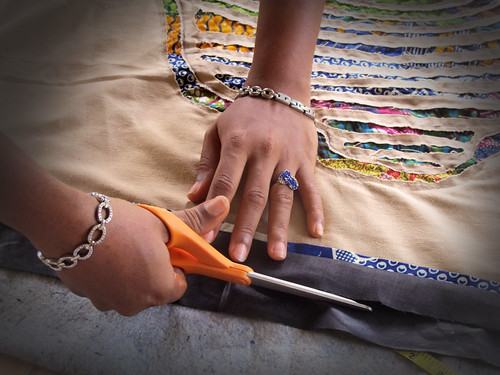
Felicia is a soft-spoken and gentle woman. Her husband attends ABC University. She has witnessed through her husband the power of education and how it can help grow and develop a person. Her own high school experience was interrupted by the birth of her first child, but she longed for this growth for herself and to model it for her children. Her desire to finish her schooling led her to Amani. Without the means to pay for her education, she came to Amani Liberia’s director looking for assistance. She was advised, “instead of relying on someone else to pay for your education, you can have a job at Amani and earn it for yourself.” Felicia considered this carefully as this would introduce her first act of independence in pursuit of her education. The result was a feeling of empowerment. The success or failure of her education would now rest in her own hands.
Felicia returned to Amani the following day eager to embark on this unknown journey of employment. She did not know what would be required. She did not know how she would perform. She was told on her first day that she would learn to cut. Felicia hesitated; she had never held a pair of scissors before. She became visibly disheartened as she fumbled with the scissors and struggled to meet the expectations required of her. Her husband, sensing her discouragement, supported her and said, “It is always good to learn something new – this is the beginning of education.”
Felicia practiced her cutting for two days and then was given patterns to cut. At the end of the month her work was tallied and her first payment delivered. As she stretched out her hand to receive her pay a big smile broke out across her face in recognition that she had just earned her school tuition. Her smile was dignity, her hope was being realized.